

Same sport, different outcome
Two athletes train the same way, play the same sport and land from the same jump. One tears an anterior cruciate ligament (ACL). The other does not. Most ACL injuries happen without any contact with another player [1]. Genes are one of several factors, alongside influences from outside the body [2]. ACL tears even seem to run in families. Earlier family studies, summarised in a 2021 meta-analysis, reported more than double the risk for people with a close relative who had one [3].
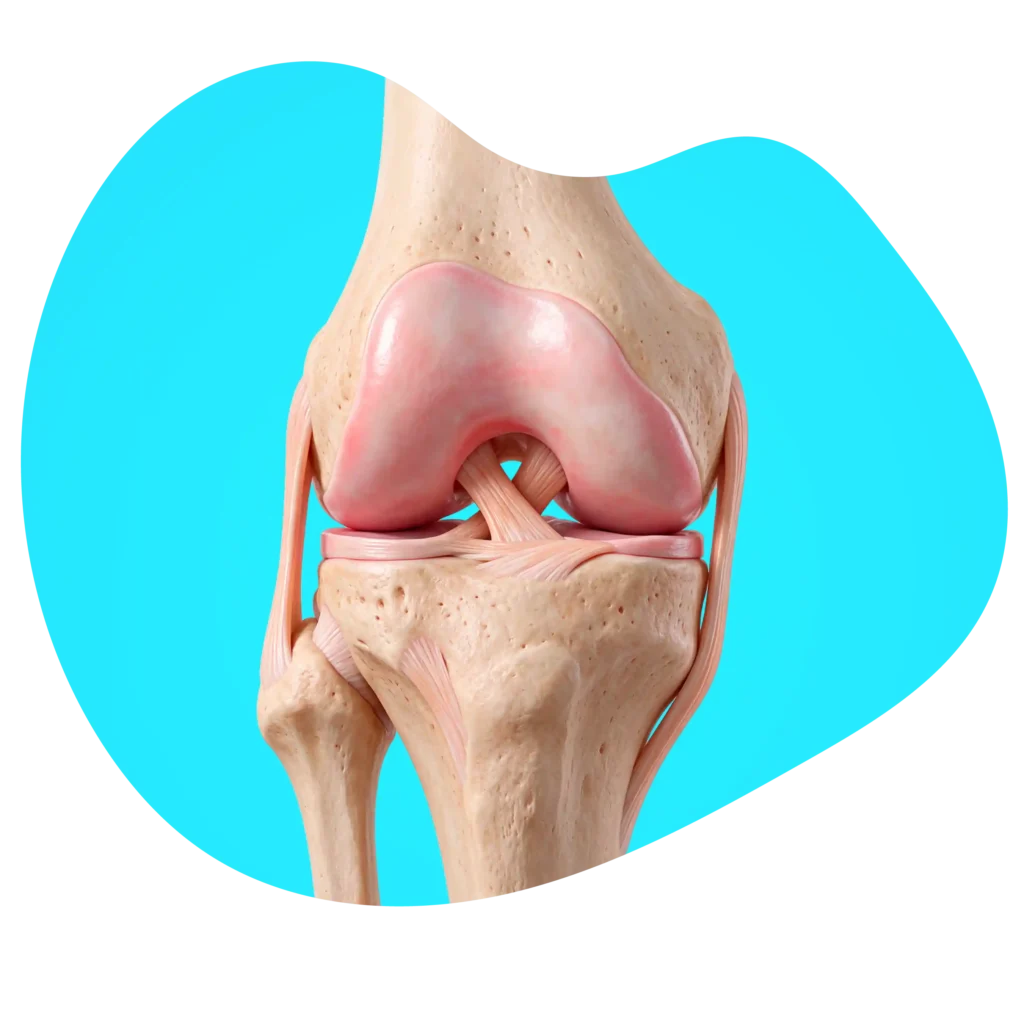

Collagen, the rope inside the ligament
A ligament works like a rope made of thousands of thin fibres, and collagen is the material those fibres are made of. It is the main structural material of a ligament [3]. Each type of collagen is built from instructions in its own gene, such as COL1A1 for type I, the main one [3].
Rare, severe changes in COL12A1 have been described as causing unusually flexible joints and weakness from birth [3]. A common variant in the same gene is a different matter: a large pooled analysis found no link with ACL injury [3].
What the research shows so far
Most studies compare small spelling differences in the DNA, called variants, between athletes who tore their ACL and those who did not. Several of them have looked at collagen genes such as COL1A1, COL5A1 and COL12A1 [4-6]. One version of COL1A1 was linked to lower risk [6]. Researchers are still refining how variants in collagen genes relate to ACL injury, and these findings do not yet allow an individual athlete’s risk to be estimated [4,7,8].
Results also differ between populations and between men and women, which is why researchers recommend analysing each group separately [7]. Variants may act together as well [9]. A 2025 meta-analysis describes an earlier study of Polish male soccer players, in which one combination of two COL5A1 variants was more common in uninjured players [5]. This suggests a possible protective effect. It still needs confirmation in other groups.

Looking at the whole genome
Genome-wide studies scan the whole DNA without choosing genes in advance. One exploratory study of 126 elite Estonian athletes looked for genetic signals linked to performance and to lower-limb injuries in general. It found 37 suggestive variants, but none specific to ACL tears [8]. The authors call for further work before such findings guide individual prevention programmes [8].
A 2026 review catalogued 70 genes and 107 variants linked to tendon and ligament injuries. It suggested that combinations of variants may explain risk better than single ones [9].
From single variants to polygenic scores
Instead of looking at one variant at a time, researchers have started to combine many into a single score [10]. In rugby, a score built from 13 variants linked to tendon and ligament injury was higher in elite players than in non-athletes [10]. The authors suggest that elite athletes may carry more favourable profiles [10]. The study compared groups of athletes, not injuries, so the next step is to link such scores with injury records [10].
A polygenic score adds up the small effects of many variants into one number. A large analysis of 84 traits, not focused on ACL injury, looked at how accurate such scores are. Accuracy changed with a person’s ancestry relative to the group used to build them [11]. This suggests that scores may benefit from testing in diverse populations, including Hispanic and Latino ones [11].
Genes, training and prevention
Prevention programmes have shown results. In four studies of female athletes, neuromuscular training was associated with a 61% lower rate of ACL injury [12]. The programmes included exercises such as balance and strength work, and the evidence was rated high-certainty [12]. How genes and training programmes interact is an open area for research [13].
Outlook
Researchers recommend larger, standardised studies [9] that include more varied ethnic backgrounds [3] and analyse men and women separately [7]. If these confirm the current links, the authors of a 2026 meta-analysis see potential for personalised injury prevention [13].
Speak to Stemwell today to find out more

Stem cell therapy represents an exciting new treatment avenue for hamstring injuries, with the potential to promote quicker healing and improve your overall quality of life. Our expert team at Stemwell are dedicated to supporting you and finding the right treatment option to meet your needs.
If you would like to find out more about stem cell therapy you can contact us with any questions, or apply today to check your eligibility.
References
1. Mattu AT, Ghali B, Linton V, Zheng A, Pike I. Prevention of non-contact anterior cruciate ligament injuries among youth female athletes: an umbrella review. Int J Environ Res Public Health. 2022;19(8):4648. doi:10.3390/ijerph19084648
2. Ribbans WJ, September AV, Collins M. Tendon and ligament genetics: how do they contribute to disease and injury? A narrative review. Life (Basel). 2022;12(5):663. doi:10.3390/life12050663
3. Lv Z, Wang W, Zhao D, Huang J. COL12A1 rs970547 polymorphism does not alter susceptibility to anterior cruciate ligament rupture: a meta-analysis. Front Genet. 2021;12:665861. doi:10.3389/fgene.2021.665861
4. Candela V, Longo UG, Berton A, Salvatore G, Forriol F, de Sire A, et al. Genome-wide association screens for anterior cruciate ligament tears. J Clin Med. 2024;13(8):2330. doi:10.3390/jcm13082330
5. Sun Z, Cięszczyk P, Bojarczuk A. COL5A1 rs13946 polymorphism and anterior cruciate ligament injury: systematic review and meta-analysis. Int J Mol Sci. 2025;26(13):6340. doi:10.3390/ijms26136340
6. Bulbul A, Ari E, Apaydin N, Ipekoglu G. The impact of genetic polymorphisms on anterior cruciate ligament injuries in athletes: a meta-analytical approach. Biology (Basel). 2023;12(12):1526. doi:10.3390/biology12121526
7. Sun Z, Cięszczyk P, Humińska-Lisowska K, Michałowska-Sawczyn M, Yue S. Genetic determinants of the anterior cruciate ligament rupture in sport: an up-to-date systematic review. J Hum Kinet. 2023;88:105-17. doi:10.5114/jhk/163073
8. Ebert JR, Magi A, Unt E, Prans E, Wood DJ, Koks S. Genome-wide association study identifying variants related to performance and injury in high-performance athletes. Exp Biol Med (Maywood). 2023;248:1799-805. doi:10.1177/15353702231198068
9. Marrouh A, El Haddouchi A, Kartti S, El Fahime E, Boutayeb S, Chagar Y, et al. Genetic determinants of tendon and ligament injuries in athletes: a narrative review from single variants to gene-gene interactions. Front Syst Biol. 2026;6:1858521. doi:10.3389/fsysb.2026.1858521
10. Brazier J, Antrobus MR, Herbert AJ, Callus PC, Khanal P, Stebbings GK, et al. Gene variants previously associated with reduced soft-tissue injury risk: part 2 – polygenic associations with elite status in rugby. Eur J Sport Sci. 2023;23(8):1779-88. doi:10.1080/17461391.2022.2155877
11. Ding Y, Hou K, Xu Z, Pimplaskar A, Petter E, Boulier K, et al. Polygenic scoring accuracy varies across the genetic ancestry continuum. Nature. 2023;618(7966):774-81. doi:10.1038/s41586-023-06079-4
12. Bullock GS, Räisänen AM, Martin C, Martin M, Galarneau JM, Whittaker JL, et al. Prevention strategies for lower extremity injury: a systematic review and meta-analyses for the Female, woman and girl Athlete Injury pRevention (FAIR) Consensus. Br J Sports Med. 2025;59(22):1575-86. doi:10.1136/bjsports-2025-109910
13. Łosińska K, Cięszczyk P, Zając A, Markowski J, Pilch J, Smółka W, et al. Genes and injuries in sports: a systematic review and meta-analysis. J Hum Kinet. 2026;101:179-98. doi:10.5114/jhk/218951
