

A knee injury can disrupt your plans in an instant. Perhaps it happened during a football match, while pivoting in training, or when landing from a jump. Once the initial pain and swelling set in, a very natural question often follows: Will I be able to return to the activities I enjoy?
If you have been told that you may have injured your anterior cruciate ligament (ACL), you may have questions about physiotherapy, surgery, and cell-based therapies currently being studied as potential complementary approaches. Understanding what is known about each option can help you have an informed conversation with your doctor and make decisions with greater confidence.
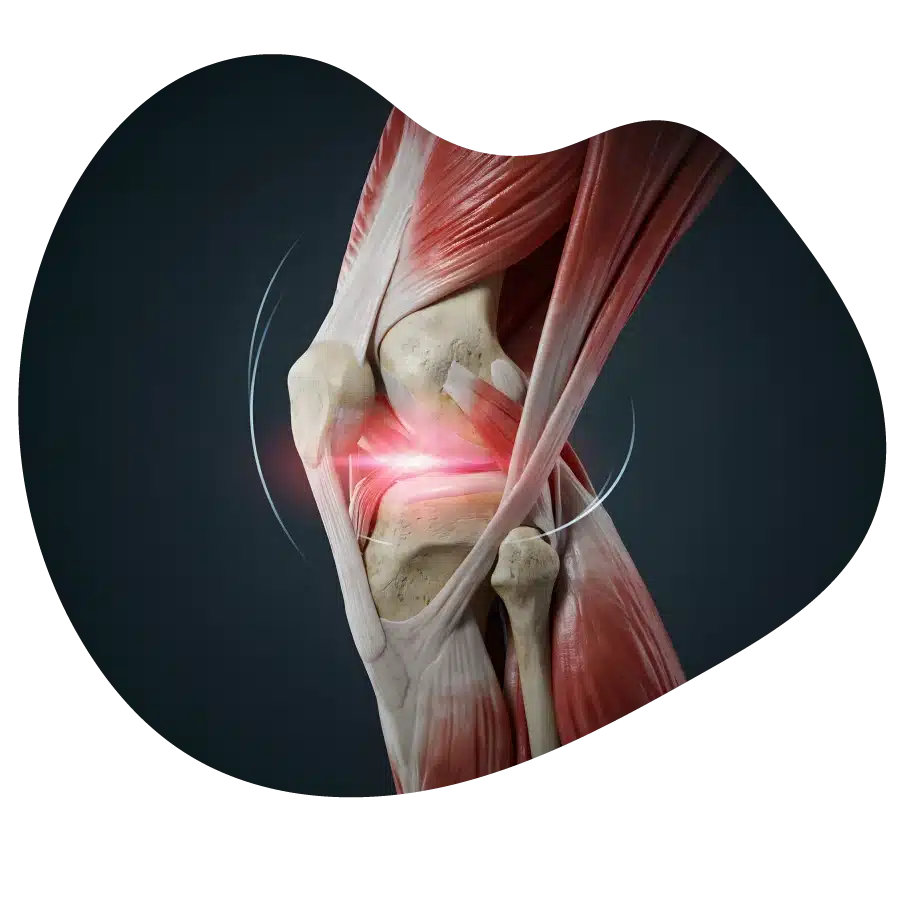

What Is the Anterior Cruciate Ligament?
The ACL is a strong band of tissue inside the knee. It helps keep the joint stable when we walk, turn, stop suddenly, or change direction. This makes it important not only in sport but also in many everyday activities.
The ACL can be injured when the knee twists suddenly while the foot remains planted. Some people feel or hear a pop, followed by pain or swelling; others notice that their knee gives way when walking or turning. The ligament may be partially or completely torn, and other structures within the knee may also be affected.
How Can You Tell How Serious the Injury Is?
An assessment begins with a discussion of how the injury occurred, the symptoms you are experiencing, and the activities you hope to resume. Your clinician will then examine your knee. Depending on the findings, an MRI scan may be recommended to assess the ligament and surrounding structures.
Seek medical attention promptly if you cannot bear weight, experience severe pain, notice an obvious deformity, lose sensation, or find that your foot feels cold.
What Treatment Options Are Available?
Not everyone needs the same treatment. In some cases, a well-structured physiotherapy program can help restore strength, balance, and confidence in movement. A knee brace may also be recommended in certain circumstances.
In other cases, surgery may be worth considering, particularly if the knee repeatedly gives way, other structures within the joint are injured, or you hope to return to sports involving rapid turns and changes of direction. Physiotherapy remains an important part of recovery whether or not surgery is performed. (1,2)
The most appropriate approach depends on the nature of your injury, your activity level, your personal goals, and an individual medical assessment.

What Are Stem Cell Therapies?
Stem cells have attracted considerable interest in regenerative medicine as researchers explore how they interact with tissues and the body’s natural repair processes. This field of research seeks to understand whether certain cell-based treatments might one day contribute to the care of injuries such as ACL tears.
Stem cell-based approaches involving cells derived from bone marrow or umbilical cord tissue are among those being explored. These approaches do not replace established treatments, such as physiotherapy or surgery, when those treatments are indicated. (3–8,10)
Not all regenerative therapies are alike: their sources, preparation methods, and modes of administration differ. Platelet-rich plasma (PRP), which is prepared from a patient’s own blood, is distinct from cell-based therapies. Findings associated with one approach should therefore not automatically be applied to another. Any proposed treatment requires an individual assessment of the injury, the available evidence, and the patient’s needs. (3–8,10)
What Should You Ask Before Considering This Type of Therapy?
It is understandable to want to explore newer options, particularly if surgery or a lengthy recovery is a concern. Before making a decision, ask which product is being proposed, where it comes from, how it would be administered, what benefits have been observed, and what remains uncertain. You should also ask about potential risks, including pain, swelling, infection, or unwanted reactions and what is known about long-term safety.
Early clinical studies have explored the feasibility and safety of MSC-based approaches, but current evidence is not sufficient to establish their efficacy for preventing, slowing, or treating Alzheimer’s disease. [10].
Rehabilitation Is Also Essential to Recovery
Relief from pain is only one part of recovery. Your knee also needs to regain strength, balance, and control to cope with everyday movement. Physiotherapy supports this process through exercises tailored to each stage of recovery. (1)
Returning to sports involving jumping, pivoting, or sudden changes of direction requires particular care. No single recovery timeline can guarantee a safe return for everyone: what matters is how well your knee functions and how confident you feel using it. (9)
Looking Ahead with Clear, Reliable Information
Research in regenerative medicine is raising promising questions about new ways to support tissue recovery. However, for ACL injuries, cell-based therapies have not yet been shown to consistently improve the outcomes that matter most to patients, such as knee stability or a safe return to their usual activities. Further research will help clarify both their potential and their limitations. (3,4,10)
If you experience pain, episodes of knee instability, or uncertainty about your recovery, a medical assessment can help you understand your options. The first step is to understand your injury and set realistic expectations.
Speak to Stemwell today to find out more

Stem cell therapy represents an exciting new treatment avenue for hamstring injuries, with the potential to promote quicker healing and improve your overall quality of life. Our expert team at Stemwell are dedicated to supporting you and finding the right treatment option to meet your needs.
If you would like to find out more about stem cell therapy you can contact us with any questions, or apply today to check your eligibility.
References
1. Kotsifaki R, Korakakis V, King E, Barbosa O, Maree D, Pantouveris M, et al. Aspetar clinical practice guideline on rehabilitation after anterior cruciate ligament reconstruction. Br J Sports Med. 2023;57(9):500-514. doi:10.1136/bjsports-2022-106158. https://pubmed.ncbi.nlm.nih.gov/36731908/
2. Brophy RH, Lowry KJ. American Academy of Orthopaedic Surgeons Clinical Practice Guideline Summary: Management of Anterior Cruciate Ligament Injuries. J Am Acad Orthop Surg. 2023;31(11):531-537. doi:10.5435/JAAOS-D-22-01020. https://pubmed.ncbi.nlm.nih.gov/36727995/
3. Driscoll A, Mazzocco J, Fucaloro S, Sun C, Bragg J, Puzzitiello R, et al. Orthobiologic augmentation for anterior cruciate ligament reconstruction is not associated with improved clinical or radiographic outcomes: a systematic review and meta-analysis of randomized controlled trials. Arthroscopy. 2026 Oct 5. doi:10.1002/arj.70638. https://pubmed.ncbi.nlm.nih.gov/42832231/
4. Park JY, Cheung JANH, Todorov D, Park SY, Lim H, Shin E, et al. Biological augmentation of anterior cruciate ligament reconstruction with bone marrow aspirate concentrate: a systematic review and meta-analysis of randomised controlled trials. Int Orthop. 2025;49(1):35-43. doi:10.1007/s00264-024-06380-5. https://pubmed.ncbi.nlm.nih.gov/39572452/
5. Lin YC, Chen YJ, Fan TY, Chou PH, Lu CC. Effect of bone marrow aspiration concentrate and platelet-rich plasma combination in anterior cruciate ligament reconstruction: a randomized, prospective, double-blinded study. J Orthop Surg Res. 2024;19(1):4. doi:10.1186/s13018-023-04512-y. https://pubmed.ncbi.nlm.nih.gov/38169406/
6. Baird JPE, Anz A, Andrews J, Plummer HA, McGowan B, Gonzalez M, et al. Cellular augmentation of anterior cruciate ligament surgery is not currently evidence based: a systematic review of clinical studies. Arthroscopy. 2022;38(6):2047-2061. doi:10.1016/j.arthro.2021.11.056. https://pubmed.ncbi.nlm.nih.gov/34921956/
7. Centeno CJ, Berger DR, Pitts J, Markle J, Pelle AJ, Murphy M, et al. Non-surgical treatment of anterior cruciate ligament tears with percutaneous bone marrow concentrate and platelet products versus exercise therapy: a randomized-controlled, crossover trial with 2-year follow-up. BMC Musculoskelet Disord. 2025;26(1):882. doi:10.1186/s12891-025-09153-2. https://pubmed.ncbi.nlm.nih.gov/41029301/
8. Hexter AT, Thangarajah T, Blunn G, Haddad FS. Biological augmentation of graft healing in anterior cruciate ligament reconstruction: a systematic review. Bone Joint J. 2018;100-B(3):271-284. doi:10.1302/0301-620X.100B3.BJJ-2017-0733.R2. https://pubmed.ncbi.nlm.nih.gov/29589505/
9. Meredith SJ, Rauer T, Chmielewski TL, Fink C, Diermeier T, Rothrauff BB, et al. Return to sport after anterior cruciate ligament injury: Panther Symposium ACL Injury Return to Sport Consensus Group. Knee Surg Sports Traumatol Arthrosc. 2020;28(8):2403-2414. doi:10.1007/s00167-020-06009-1. https://pubmed.ncbi.nlm.nih.gov/32347344/
10. Waller G, Truett J, Anz A. Orthobiologic use in ligament reconstruction and repair. Clin Sports Med. 2025;44(4):763-774. doi:10.1016/j.csm.2024.12.008. https://pubmed.ncbi.nlm.nih.gov/41101909/
